
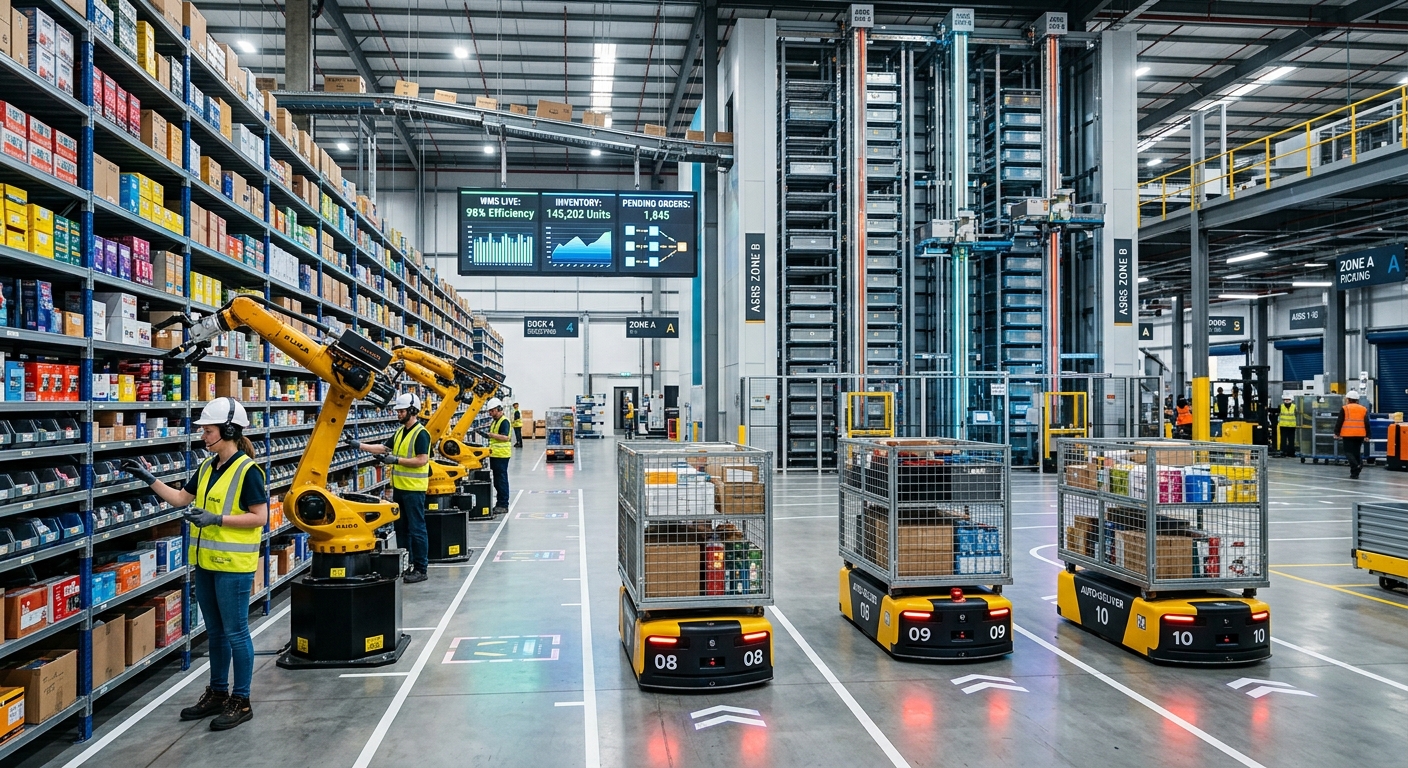
Warehouse automation is finally getting the recognition it deserves, as estimates suggest its adoption will increase by 10% per year. Additionally, some industry forecasts suggest that robot shipments will increase by up to 50% by 2030.
These estimates are arriving after several supply chain disruptions have helped industries realize the true value of automation. Previously, inefficiencies such as excess stock were simply considered routine parts of business, but modern supply chains increasingly use dynamic, data-driven automation technologies. Warehouses no longer need to wait until it’s too late to identify a problem.
Types of Warehouse Automation
Before we get into specific warehouse automation technologies, it’s important to understand the difference between physical and digital automation, as this distinction is relevant to the company’s scale and goals.
Digital automation generally involves Warehouse Management Systems (WMS) and Warehouse Control Systems (WCS). These software manage and coordinate warehouse operations; for example, WMS systems oversee operations by tracking inventory levels, recording where products are stored, receiving incoming shipments, managing customer orders, and/or deciding which products workers should pick. WCS systems, on the other hand, control the automated equipment, such as conveyor belts and robots, to ensure they work in coordination.
Many large-scale modern warehouses use both systems in an integrated platform, whereas older warehouses typically relied on separate WMS and WCS software that worked independently.
Physical automation refers to automated equipment that performs the manual tasks within a warehouse that a human worker would otherwise be required to perform. This may include conveyors, robotic picking arms, AGVs, and automated sorters. These increase warehouse efficiency and are generally preferred in large-scale warehouses.
For small, retail-level warehouses, digital automation is generally adopted first to maximize efficiency. Physical automation only makes sense when the order count is larger–going into thousands daily and/or when the warehouse requires faster order fulfillment, needs 24/7 operations, wishes to reduce workplace injuries, or is facing labor shortages.
Common Warehouse Automation Technologies
This section discusses some of the most common warehouse automation technologies that are transforming supply chains today.
Automated Storage and Retrieval Systems (ASRS)
ASRS refers to equipment such as Vertical Lift Modules (VLMs), carousel systems, and shuttle systems that automatically store and retrieve goods. Of course, ASRS equipment requires a high up-front investment, but the ROI is clear: industry estimates suggest these systems can free up 60% to 85% of floor space compared with traditional shelving methods. They also offer higher accuracy in picking and inventory control.
Additionally, with ASRS, there is a greater need to select the right equipment type based on throughput requirements, SKUs, and facility constraints, as different types serve different needs. VLMs, for example, are suitable for warehouses with limited floor space but greater vertical space. Shuttle systems are best used for high-throughput environments that require fast retrieval. Finally, carousel systems are suggested for medium-volume operations, since they are designed for smaller items.
Automated Guided Vehicles (AGVs) and Autonomous Mobile Robots (AMRs)
AGVs and AMRs are part of advanced warehouse robotics that help move goods around the warehouse, for example, from the receiving dock to storage. These machines often work with humans, robotic picking arms, or cobots (more on those below!) rather than picking items individually.
AGVs follow fixed routes and navigate their way around the warehouse using magnetic strips, wires, or painted floor lines or markers. They are best implemented for high-volume, repetitive transportation routes. AMRs, on the other hand, can independently navigate the warehouse using LiDAR sensors, artificial intelligence, and advanced safety protocols. They’re able to detect and avoid obstacles in real time, so they’re valuable for warehouses with changing layouts.
Robotic Picking Arms
AGVs and AMRs don’t actually pick out goods to transport. To fill that gap, robot picking arms use AI-powered and machine vision to identify, pick, and place individual goods. They’re useful for routine and predictable handling of goods. Interestingly, robotic arms can employ advanced end-of-arm tooling (EoAT) to replicate human dexterity. These can vary in size and may be used for palletizing or depalletizing stock, or for handling small, delicate items without damaging them.
Collaborative Robots (Cobots)
Cobots free up humans to handle the complex decision-making within a warehouse. They’re designed to safely perform routine, repetitive machine tending, assembly, packaging, and quality inspection using technologies such as artificial intelligence (AI), machine learning, and advanced sensors. According to the International Federation of Robotics, after implementing cobots, one manufacturer reported a 200% increase in welding production and a 600% increase in machine tending. Many cobots are designed with rounded, human-friendly sides and soft edges so they can be used alongside humans.
Conveyor and Sortation Systems
Roller conveyors have been around for a long time now, but modern conveyors employ interchangeable sections, high-speed sortation, automated merging or diverting, and intelligent controls. Their modular design means that conveyor sections can be added, removed, or rearranged. The intelligent controls also help coordinate the entire conveyor system.
Despite their benefits, these systems require a dedicated space, initial setup, and periodic maintenance, so they may be useful only for large-scale warehouses.
Internet of Things (IoT)
The hallmark of a fully automated warehouse system is the unparalleled visibility it provides. An IoT system allows managers to track inventory, vehicles, and other equipment by using sensors, RFID tags, and smart devices that collect and share data throughout the warehouse. The benefits of an IoT system far outweigh the costs of sensors and devices and may include real-time data, predictive analytics, protection against inventory theft, and environmental monitoring.
AI-Powered Warehouse Management Systems (WMS)
AI-powered WMSs differ from traditional WMSs in that they use AI to analyze real-time data and automatically optimize warehouse operations without constant human input. A traditional WMS mainly tracks inventory and manages warehouse operations. Aside from intelligent slotting, automatic replenishment, and dynamic labor allocation, these systems also offer features such as predictive analytics, which study historical sales, seasonal trends, and current orders to forecast future demand. These are scalable to accommodate growth, but integrating them into existing systems can be complex.
Challenges of Warehouse Automation
With all the benefits of warehouse automation, there are some specific technical and strategic challenges that companies must remain mindful of. Many warehouse automation projects fail because companies lack a cohesive strategy for deploying automated systems, have an inadequate understanding of automated technologies, and/or experience misalignment among different stakeholders in the company.
For one, companies have various automation options at their disposal, and they must compare each technology, evaluate numerous vendors, and consider sourcing and partnership options. Of course, this is an arduous task in itself.
Automation projects also come with tremendous financial risks, due to higher capital costs, longer payback periods and implementation timelines, and execution risk.
There’s also the risk of creating “automation islands,” where only specific warehouses or processes have been automated, and the rest of the warehouse remains disconnected. This can prove to be an obstacle in fully reaping the benefits of a truly automated warehouse.
Robots also can’t work in a vacuum. Alongside these systems, companies must employ reliable operational data, a robust IT infrastructure, and communication channels with employees during the implementation process.
Speaking of employees, automation can only work alongside employees who have up-to-date technical skills. Thus, companies may need to either retrain existing employees, retain specialized talent, redesign job roles, or recruit skilled workers.
Lastly, employing warehouse automation technologies is a long process. Companies must procure equipment, integrate different technologies, conduct extensive testing, and roll out systems gradually. There must also be contingency plans in place to minimize disruptions in the existing supply chains.