
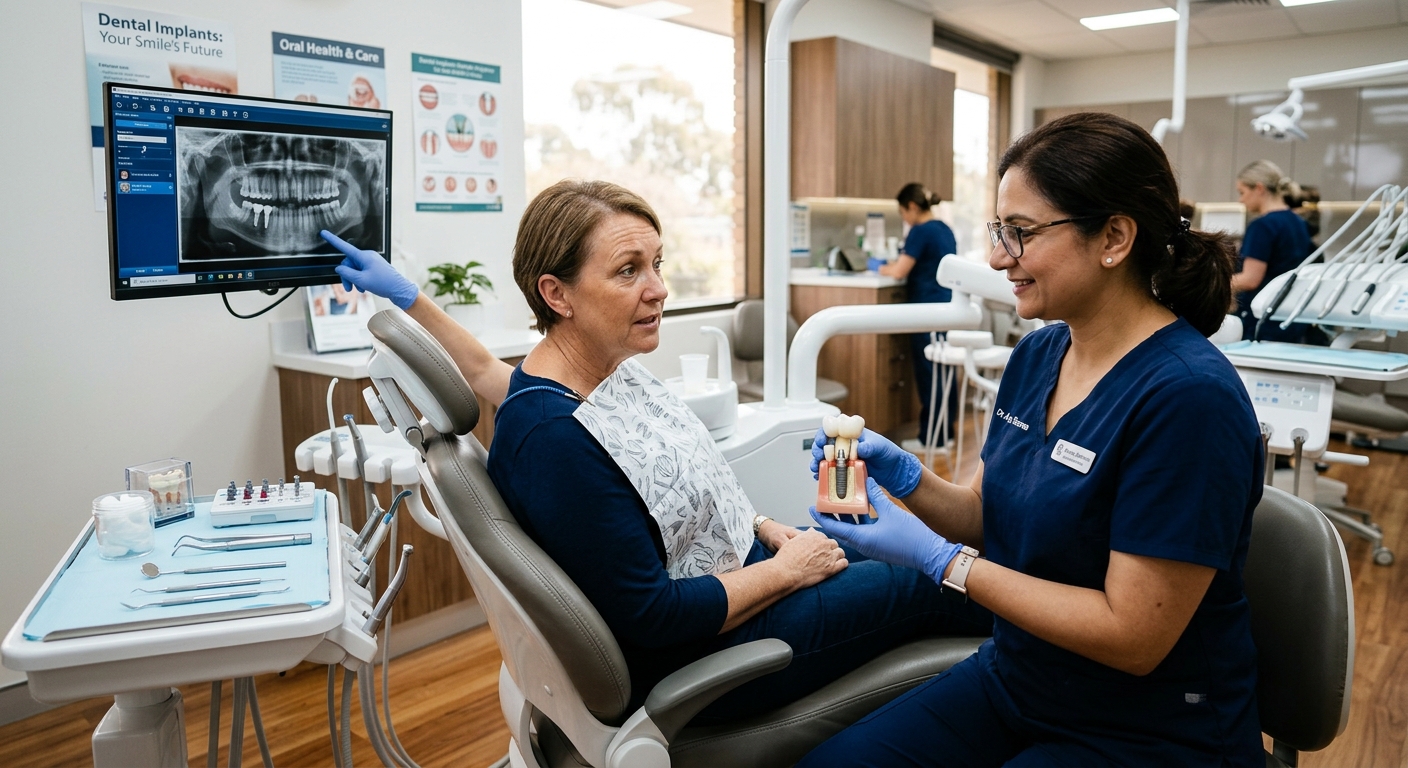
Losing a tooth (or several teeth) is frustrating in that it can make chewing food more difficult, affect your speech, and, perhaps most importantly, leave you feeling self-conscious. You can get by with temporary workarounds (such as removable dentures or temporary partial dentures), but the only real long-term, effective solution for your missing teeth is dental implants. With dental implants, it is almost impossible to tell whether your smile is natural or the result of some fine craftsmanship.
Of course, there’s one question that’s on almost everyone’s mind: how much do dental implants cost? To be fair, the process generally carries a higher price tag, but the cost depends on many factors, such as your overall oral health, the number of implants you need, and whether you require any additional procedures before starting treatment.
What Procedures are Involved in Dental Implants?
A dental implant is a lengthy process, and generally, the following steps are involved.
Initial Consultation and Examination
The process begins with a consultation and examination in which your dentist assesses your gums, jawbones, and teeth. They may also request X-rays, 3D scans, photographs, and an impression of your mouth. This is done to assess whether your jaw and gums are strong enough to support an implant, or if you need any additional treatment before the implant.
Getting the Area Ready for Implant
If you still have the damaged teeth, the dentist may remove them first, and in most cases, this is followed by placing the implant. But sometimes, depending on the condition of your bone and gums, your dentist may leave it to heal.
If your dentist determines that your jawbone is not strong enough to support the implant, they may recommend bone grafting. Bone grafting is a procedure in which your jawbone is given extra support so it can better support the implant.
Implant Placement
When it comes to placing the implant, the area is numbed with local anesthesia. The dental surgeon then makes a small opening in the gum and places the screw-shaped implant post into the jawbone. The material (implant post) is made of titanium, but it can also be another material. After placing the post, the gum is closed and left to heal.
Healing and Osseointegration
As the area heals, the implant becomes firmly integrated with the bone and creates a stable base for the replacement of the tooth. The healing process can take up to six months, but the timing may vary from patient to patient.
Abutment Attachment
Your dentist will assess whether the implant post is firmly connected to your bone. If it has, they will attach a small connector to your implant post. This is called an abutment, which connects the implant post and the crown.
Crown Creation and Placement
This process involves examining your teeth, their color, and size so that a perfect crown (artificial tooth) can be created. Once it is ready, it is attached to the abutment, and the process is complete. During this process, your dentist will check your bite and make adjustments so that your newly implanted tooth feels comfortable and looks identical to the rest of your teeth.
How Much Do Dental Implants Cost?
Since the process is highly sophisticated, involving multiple steps, instruments, and procedures, the price tag is also higher. You can expect to spend anywhere from $3,000 to $6,000 to get a single tooth replaced with a dental implant. This cost covers the major components involved in the process (the implant post, abutment, and crown), but other expenses can also add up.
Other Costs
When you go for a dental implant, X-rays, impressions, and 3D scans are a must; without them, it won’t be possible to complete the procedure. Similarly, you might require additional procedures, such as tooth extraction, bone grafting, or sinus lifting, before placing the implant. None of these procedures is covered by the cost of a dental implant.
It usually costs less to replace a single tooth with a dental implant. But as the number of teeth increases, your cost will also increase. Similarly, an implant-supported bridge or a full-arch restoration will cost more than replacing a single tooth.
Location and Your Dental Provider
Location also influences the cost of a dental implant. If your dentist is located within a suburban area, your dental implant will likely cost less than in a major metropolitan city like New York. Similarly, if you’re getting the dental implant from a general dentist, the cost may be lower than having the same procedure performed by a specialist.
Understanding the Treatment Options
There are different treatment options for replacing missing teeth. Your dentist uses different strategies depending on how many teeth are missing and where they are located. Below is a roadmap that can walk you through the different treatment paths.
Single Tooth Implant
If you’re missing a single tooth, you will be treated with a single-tooth implant. Your dentist will place an implant post, which will be connected to an abutment. Finally, a custom-made crown will be placed on the abutment. This implant will not disturb the neighboring teeth, and the post and abutment will support themselves. However, it can take up to six months for the implant to heal before an artificial tooth is placed on it.
Impant-Supported Bridge
In cases where you’ve lost two to four adjacent teeth, instead of placing one implant for each missing tooth–which can be both expensive and frustrating–your dentist may recommend an implant-supported bridge. In this treatment, only two dental implants are placed, one at each end of the gap. These implants support a bridge of two to four artificial teeth. The middle teeth are not attached to individual implants; instead, they are suspended between the two implants and supported by them, just like a traditional bridge.
This treatment might cost less than replacing each tooth individually, but it can become difficult to clean between the artificial teeth.
The “All-on-4” or Full-Arch Fixed Bridge
This treatment is often recommended for people who have lost all or most of their teeth in the upper or lower jaw. Instead of placing one implant for every missing tooth, your dentist uses just four implants to support a full arch of replacement teeth. Two implants are placed vertically at the front of the jaw, while the two at the back are angled to provide extra support and stability.
The full bridge is permanently attached to these implants, so it does not need to be removed at night like traditional dentures. You can eat, speak, and smile with confidence, and care for the bridge by brushing daily and cleaning underneath it with special floss or a water flosser.
Implant-Supported Dentures
It’s possible that dental implants are not the right choice for you, either because of their high cost or because your bone density is too thin to support dental implants. You might also dislike the idea of having artificial teeth you can’t remove at night. In these cases, your dentist may recommend implant-supported dentures. These dentures are attached to a few dental implants, usually four to six, which hold them securely in place. They won’t slip while you’re eating or speaking, but you can easily remove them whenever you wish to clean them.